
Exercise ball toning exercises are a simple and effective way to improve strength, balance, and core stability while adding variety to your workouts.
Most people either:
- Ignore them completely at the gym
- Use them as a chair for about three days before giving up
- Assume they’re only for rehab workouts or beginner fitness
But if you’ve ever actually trained properly with an exercise ball, you know those giant inflatable things can humble you very quickly.
The reason? Instability.
The moment you add instability to an exercise, your body has to work harder to maintain control, balance, and proper form. Suddenly your core is firing constantly, stabilizer muscles wake up, and movements that look simple become surprisingly challenging.
And the best part? Exercise ball workouts are incredibly effective without being brutal on your joints.
That makes them a great option for:
- Home workouts
- Recovery training
- Core development
- Functional fitness
- Adding variety to your routine
If you’re looking to improve balance, strengthen your core, and tone your body from head to toe, these four exercise ball moves are a great place to start.
Why Exercise Ball Workouts Actually Work
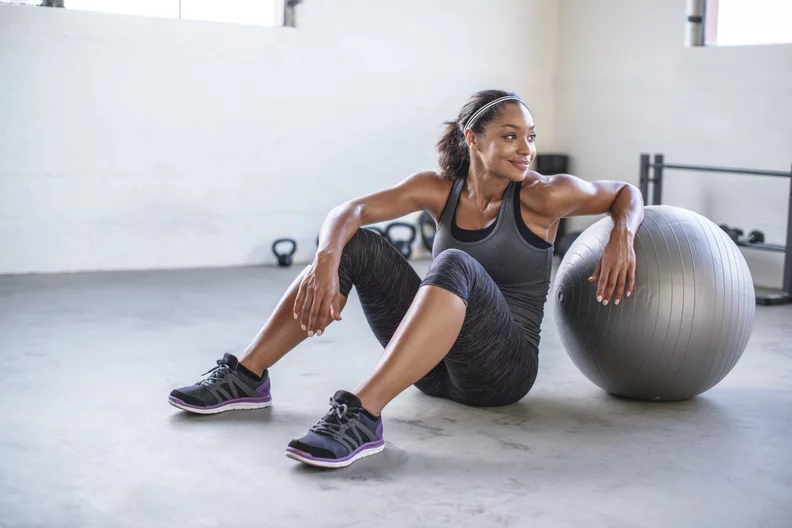
Before diving into the exercises, it helps to understand why stability ball training is so effective.
Unlike traditional exercises done on stable ground, exercise ball movements force your body to constantly adjust and stabilize.
That means you recruit:
- More core muscles
- Smaller stabilizer muscles
- Better balance and coordination
Research has shown that unstable surface training can improve:
- Core activation
- Posture
- Functional movement
- Joint stability
And because many movements are low impact, exercise balls are easier on your knees, hips, and lower back than some traditional workouts.
Plus, let’s be honest—using one makes you feel mildly athletic even when you’re wobbling around trying not to fall off.
1. Star Reach
Targets: Abs, obliques, butt, and legs
This movement combines balance, core strength, and lower-body activation all at once. It looks graceful. It may not feel graceful the first few tries.
How to Do It
- Stand with feet hip-width apart
- Hold the exercise ball in your left hand
- Extend arms out to the sides at shoulder height
- Lift your right leg out to the side as high as comfortable
- Keeping your arms in a straight line, bend your torso to the left and touch the ball toward the floor
- Keep the right leg lifted throughout the movement
- Return to the starting position
Perform 30 reps, then switch sides.
Why It Works
The instability of balancing on one leg forces your core and glutes to engage continuously. Your obliques also work overtime to stabilize the side-bending motion.
This is a fantastic movement for improving:
- Balance
- Hip stability
- Core control
And yes, your standing leg will absolutely start talking back to you after a while.
2. Peeled Push-Ups
Targets: Shoulders, chest, triceps, and abs
This move takes a modified push-up and quietly turns it into an upper-body stability nightmare—in a good way.
How to Do It
- Begin in a modified push-up position:
- Hands under shoulders
- Knees on the floor
- Feet crossed behind you
- Place the exercise ball under your right palm
- Bend your left elbow and lower your body a few inches toward the floor
- Keep the right arm straight while gently rolling the ball up the arm toward your elbow
- Keep your back straight and hips facing the floor
- Push back up using the left arm while rolling the ball back to your palm
Repeat and then switch sides.
Why It Works
This exercise combines:
- Push-up strength
- Shoulder stability
- Core engagement
Because one side is unstable, your abs and shoulders must work much harder to maintain control.
It’s also excellent for improving shoulder stability without loading heavy weight overhead.
3. Spider Triceps
Targets: Shoulders, triceps, abs, obliques, and inner thighs
This exercise sounds mildly terrifying but is actually one of the best full-body stability challenges in this workout.
How to Do It
- Lie on your right side on a mat
- Position your right elbow directly under your shoulder
- Bend your left knee with the foot flat on the floor
- Place the exercise ball between your inner thighs
- Raise your right leg slightly off the floor with toes pointed
- Extend your left arm upward
Now for the movement:
- Press into your right palm and squeeze the ball between your legs
- Straighten the right arm to push your body upward
- Lower your right foot toward the floor
- Slowly reverse back to the starting position
Perform 30 reps and switch sides.
Why It Works
This move lights up multiple muscle groups simultaneously while forcing your body to stabilize through the shoulder and core.
You’ll especially feel:
- Triceps
- Obliques
- Inner thighs
- Shoulder stabilizers
It’s one of those exercises where you suddenly realize muscles you forgot existed are now fully awake.
4. Toe Touch
Targets: Shoulders, back, abs, and hips
This exercise brings together core control, balance, and coordination.
How to Do It
- Sit on the floor with knees bent and feet flat
- Hold the exercise ball in both hands in front of your shins
- Draw your knees into your chest while leaning your torso slightly backward
- Press the ball gently into your shins and lift your feet off the floor
- Point your toes
From here:
- Engage your abs and extend your legs into a V position
- Grip the ball with your right hand and tap your toes with the ball
- Return to the tucked position
Perform 30 reps, then switch sides.
Why It Works
This movement heavily activates:
- Deep core muscles
- Hip flexors
- Shoulder stabilizers
The balance component also improves coordination and body awareness.
And yes, your abs will absolutely know they’ve been invited to participate.
The Hidden Benefit of Exercise Ball Training: Better Movement
One of the best things about exercise ball exercises is that they improve how your body functions overall—not just how it looks.
You’re training:
- Stability
- Coordination
- Mobility
- Balance
- Core control
Those are the things that carry over into everyday life and other fitness activities.
Whether you:
- Lift weights
- Run
- Cycle
- Play sports
- Or just want your body to feel better moving around
…these kinds of exercises help build a stronger foundation.
Final Thought: Don’t Underestimate the Ball
Exercise ball workouts might not look flashy.
There’s no loud music. No giant deadlifts. No dramatic gym mirror selfies.
But they work.
And sometimes the most effective workouts are the ones that quietly challenge your body in ways you weren’t expecting.
So if you’ve been overlooking the stability ball at the gym—or the one currently collecting dust in your house—it might be time to give it another shot.
Your core, balance, and joints will thank you later.