
For a long time, the fitness advice given to people as they got older was surprisingly simple: walk more.
Walking is still one of the best things you can do for your health. It’s accessible, inexpensive, good for your heart, and easy to make part of everyday life. But our understanding of healthy aging has evolved, and walking alone probably isn’t enough if your goal is to remain strong, mobile and independent well into your 60s, 70s and beyond.
The new conversation around healthy aging looks different.
It’s less about trying to look younger and more about making sure your body continues to work the way you want it to. Can you carry your suitcase through an airport? Get up from the floor without struggling? Climb several flights of stairs? Catch yourself if you stumble on an icy Edmonton sidewalk? Spend the day exploring a new city without wondering whether your knees will survive?
Those are fitness goals too.
And increasingly, research suggests three areas deserve considerably more attention as we age: strength, balance and mobility.
The good news is that you don’t have to wait until you’re “old” to start working on them. In fact, beginning in your 40s or 50s may be one of the smartest investments you can make in the person you want to be decades from now.
Healthy Aging Isn’t Just About Living Longer
We’ve become slightly obsessed with longevity.
Supplements promise it. Podcasts debate it. Billionaires fund research into it. Social media influencers have somehow turned morning routines into elaborate science experiments involving red lights, ice baths and seventeen different powders before breakfast.
But living longer and living well aren’t necessarily the same thing.
For most people, the real goal isn’t simply adding years to life. It’s preserving the ability to enjoy those years.
That’s what health professionals often describe as healthspan: the period of life spent in relatively good health and able to function independently.
That changes the fitness conversation considerably. Cardiovascular health remains incredibly important, but so does your ability to generate strength, move comfortably through different ranges of motion, maintain balance and react when something unexpected happens.
Suddenly, being able to squat becomes about much more than having strong legs. It’s about getting out of a chair easily at 75.
That’s functional fitness in its most meaningful form.
Strength May Be Your Most Important Retirement Investment
Muscle naturally becomes harder to maintain as we age, particularly when we aren’t giving the body a reason to preserve it.
That’s where resistance training becomes increasingly important.
Strength training can include barbells and dumbbells, but it doesn’t have to. Machines, resistance bands, bodyweight exercises and appropriately challenging group fitness classes can all provide resistance.
The goal is progressively asking your muscles to do work.
For healthy aging, that matters because strength supports an enormous number of everyday activities. Think about how often you need muscular strength simply to function normally: lifting groceries, carrying luggage, climbing stairs, gardening, moving furniture or getting yourself off the ground.
Canadian and international physical activity recommendations now encourage adults—including older adults—to include muscle-strengthening activities at least twice per week.
And no, you aren’t too old to start.
Research continues to demonstrate that older adults can improve strength through resistance training, even when they begin later in life.
That’s worth remembering the next time someone suggests strength training is only for 25-year-olds trying to look better on Instagram.
Train for the Life You Actually Want
One of the best ways to rethink fitness as you get older is to stop training exclusively for appearance and start training for capability.
Ask yourself what you’d like your life to look like ten, twenty or thirty years from now.
Maybe you want to travel extensively.
Maybe you want to ski with your grandchildren.
Maybe you want to golf, hike, cycle, garden or continue doing home renovations without needing three days to recover afterward.
Those goals require physical capacity.
A useful healthy-aging fitness routine might include movements that help you:
- Squat and stand comfortably
- Push and pull objects
- Carry weight
- Step up and down safely
- Rotate your torso
- Get down to and up from the floor
- Maintain stability on one leg
None of these movements are particularly glamorous.
But they’re extremely useful.
And usefulness becomes a pretty good measure of fitness as we age.
Balance Is Fitness Too
Balance is something most of us don’t think about until we begin losing it.
When you’re younger, recovering from a stumble often happens automatically. Your muscles react quickly, your nervous system coordinates the movement, and before you know it you’ve regained your footing.
That ability can decline with age.
Falls are a significant health concern among older adults, which is why physical activity guidelines specifically recommend incorporating balance-focused activities as people get older.
The important point is that balance can be trained.
It doesn’t require complicated equipment. Simple activities can challenge your balance surprisingly effectively:
- Standing on one leg
- Walking heel-to-toe
- Step-ups
- Lunges
- Yoga
- Tai chi
- Single-leg strength exercises
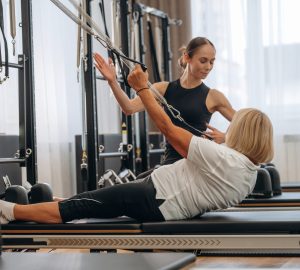
Fitness activities such as Pilates and Lagree can also challenge balance and stability because so many movements require you to control your body while resisting instability.
Balance training shouldn’t begin after you’ve already experienced a fall.
Think of it as preventive maintenance.
Mobility Isn’t the Same as Flexibility
Mobility and flexibility often get used interchangeably, but they’re not exactly the same thing.
Flexibility generally refers to how far a muscle can lengthen. Mobility involves your ability to actively control movement through a joint’s available range.
In practical terms, touching your toes is flexibility.
Being able to comfortably squat down, reach overhead, rotate your torso or step onto a high surface involves mobility.
As we age, limited mobility can gradually change the way we move. Tight hips alter our stride. Limited ankle movement affects squatting and stair climbing. Reduced shoulder mobility can make reaching overhead difficult.
And because these changes often happen slowly, we adapt without realizing it.
That’s why activities that deliberately take joints through comfortable ranges of motion can be so valuable.
Yoga, Pilates, Lagree, mobility classes and even well-designed strength training can all help.
You don’t necessarily need a separate 45-minute stretching routine every day. You simply need to keep moving your body in different ways.
Because bodies become very good at doing exactly what we regularly ask them to do.
If the only positions you practise are sitting in a chair and walking straight ahead, eventually those may become the movements your body does best.
Don’t Forget About Power
There’s another component of healthy aging that receives even less attention than balance: power.
Strength is your ability to produce force.
Power is your ability to produce that force quickly.
That distinction matters when everyday life doesn’t give you time to slowly think through a movement. If you trip on a curb, you need your leg to react immediately. If you’re carrying something and begin losing your balance, your muscles need to respond quickly enough to stabilize you.
Power tends to decline with age, which makes maintaining some ability to move quickly important.
That doesn’t mean everyone needs to start doing box jumps.
Depending on your fitness level, power training might simply involve standing up from a chair more quickly, climbing stairs with intention or performing controlled movements at different speeds.
Anyone with health concerns, injuries or significant balance issues should obviously work with an appropriate health or fitness professional before adding more challenging exercises.
The goal is capability, not recklessness.
Cardio Still Matters—This Isn’t Cardio Versus Strength
None of this means we should stop walking, cycling, swimming or running.
Healthy aging isn’t an either/or equation.
Aerobic exercise supports cardiovascular health, brain health, endurance and overall wellbeing. Current guidelines continue to recommend at least 150 minutes of moderate-to-vigorous aerobic activity each week for adults, including those over 65 who are able to participate.
The difference is that a complete healthy-aging routine should ideally include more than cardio.
Think of it as building a diversified investment portfolio for your body:
Cardio helps you keep going.
Strength helps you keep doing.
Mobility helps you keep moving.
Balance helps you stay upright.
That combination gives you a much better chance of maintaining the kind of independence most of us say we want.
What Could a Healthy-Aging Week Actually Look Like?
This doesn’t need to become another complicated wellness project.
For many people, a realistic week might look something like this:
Two or three strength sessions focusing on major muscle groups and functional movements.
Several walks, bike rides or other cardiovascular activities spread throughout the week.
Short mobility work before or after workouts or even while watching television.
Balance exercises several times per week, which can easily be incorporated into strength sessions, yoga or other activities.
The exact routine will depend on your age, experience, injuries and goals.
What matters most is developing a pattern you can sustain.
A perfect training program followed for three weeks isn’t nearly as valuable as a pretty good one you continue for twenty years.
Your 50s Aren’t the Time to Start Slowing Down
There’s a strange cultural expectation that getting older should automatically mean doing less.
Maybe we should flip that idea.
Your 40s and 50s can be the time when fitness becomes more intentional.
You may no longer care as much about how much you can bench press or what your body looked like at 25. Instead, you begin thinking about what you want your body to be capable of at 65, 75 and 85.
That doesn’t mean obsessing about aging.
It means preparing for it.
Strength training today makes carrying groceries easier tomorrow. Mobility work today helps you move more comfortably later. Practising balance now may help you stay confident on your feet decades from now.
These aren’t vanity goals.
They’re independence goals.
The New Rules of Healthy Aging
Perhaps the biggest shift in how we think about aging is recognizing that decline isn’t something we simply have to accept without resistance.
Yes, bodies change.
Recovery may take longer. Muscle becomes harder to maintain. Joints remind us about questionable decisions made in our twenties.
But there is still an enormous amount within our control.
Move regularly.
Lift things.
Challenge your balance.
Keep your joints moving.
Walk, cycle, swim or run.
Try activities that make you use your body differently.
And don’t wait until you feel old to start training for getting older.
Because the ultimate goal of fitness isn’t necessarily living forever.
It’s reaching the later chapters of your life strong enough, mobile enough and confident enough to keep saying yes to the things you still want to do.